







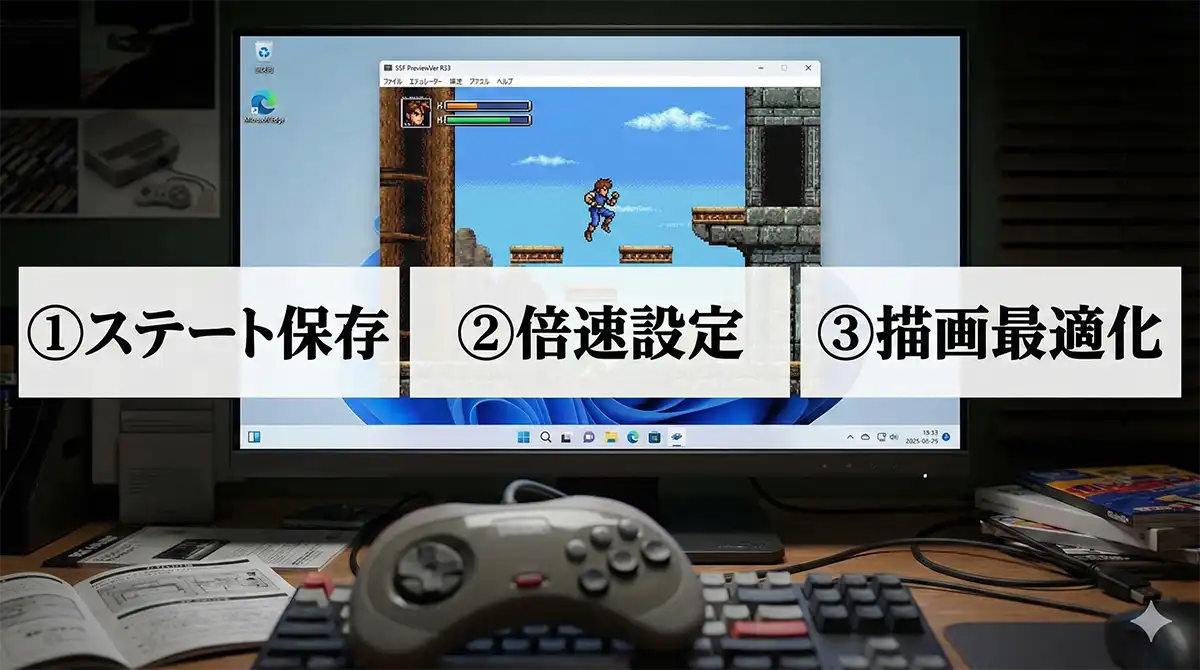
SSF is the Sega Saturn emulator most people on Windows end up using, and the version this guide was tested against is PreviewVer R33. Getting it running is one thing. Knowing which three features to reach for once it is running is what actually makes a Saturn library playable on a modern PC.
This guide assumes you already have SSF running with a game booting. It does not cover installation or gamepad mapping. What it covers is the part nobody writes down: how save states really work in R33, why the speed multiplier is not where you expect it to be, and which video settings are worth changing on a modern widescreen monitor.
- Why Saturn emulation is a bigger deal in North America
- The quick reference (come back to this table)
- Save states: stop anywhere, retry anything
- The speed multiplier is in SSF.ini, not in the Option menu
- Video settings: everything lives under Option → Screen
- Troubleshooting the three things that actually go wrong
- On legality
- A short checklist before your next session
Why Saturn emulation is a bigger deal in North America
If you grew up with a NES, a SNES or a Genesis, the Saturn is probably the console-shaped hole in your memory. Sega launched it in North America in 1995 ahead of its announced date, priced above the PlayStation that followed months later, and never recovered commercially; support ended in 1998. The North American library stayed a fraction of the size of the Japanese one, and many of the games people now want most had small print runs or never left Japan.
The practical consequence is simple: secondhand Saturn discs are expensive and inconsistently available, and a thirty-year-old console with a working laser is not a given. That is the honest reason emulation matters more for this platform than for a Genesis or a SNES.
The quick reference (come back to this table)
Everything below expands on these five actions. If you memorise nothing else, memorise the first two rows.
| What you want | Keys | How you know it worked |
|---|---|---|
| Save a state | Shift + F7, then 0-9 | “Select Save No. 0-9” appears at the top left |
| Load a state | F7, then 0-9 | The game jumps straight back to that moment |
| Change speed multiplier | Key defined in SSF.ini | The indicator at the top of the screen changes, for example x1 to x3 |
| Toggle scanlines | Shift + L | Horizontal lines appear over the picture |
| Toggle bilinear filtering | Shift + B | Edges go from sharp pixels to smoothed |
Save states: stop anywhere, retry anything
Saturn games are from an era with no autosave and no checkpoint density. Long dungeon runs, unskippable cutscenes before boss fights, one-shot dialogue choices in RPGs. Save states are the feature that makes those games fit into an adult evening.
Saving: Shift + F7, then a number
Press Shift + F7. SSF displays “Select Save No. 0-9” in the top left corner of the screen. Press any key from 0 to 9, and the state is written to that slot. That is the whole operation. It does not pause the game for long and it does not open a dialog box.
The prompt is the part people miss. If you press Shift + F7 and nothing appears in the corner, the keystroke never reached SSF – see the troubleshooting section below, and do not press a number, because the game itself may read it.
Loading: F7, then the same number
Press F7 on its own, then the slot number, and the game snaps back to exactly where that state was written. No shift key this time. That asymmetry is deliberate and it is easy to get muscle memory for: shift means write, no shift means read.
The menu route, for when you forget the hotkeys
Every one of these actions also lives in the menu bar at the top of the SSF window. Go to File → State Save or File → State Load, then choose a slot from 0 to 9. It is slower, but it is the safety net when you come back to the emulator after a few months and the key combination has evaporated from your memory.
Give your slots fixed jobs
Ten slots sounds like plenty until you overwrite the one that mattered. The fix is to assign each slot a permanent role and never improvise. A scheme that works well:
- Slot 0 – the rolling “most recent” slot. Overwrite this one constantly without thinking.
- Slot 1 – immediately before a boss. Written once per boss, then reused for the next one.
- Slot 2 – before an irreversible branch: a dialogue choice, a point of no return, a missable item.
Slots 3 to 9 stay free for whatever a game demands. Slot 0 is the only one you ever overwrite carelessly, so a bad save never costs more than a few minutes.
The speed multiplier is in SSF.ini, not in the Option menu
This one catches people out, so it is worth stating plainly: in R33 there is no speed multiplier entry in the Option menu. Looking for a dropdown or a checkbox there is a dead end. The key that changes the multiplier is defined in SSF.ini, the emulator’s configuration file.
When the multiplier does change, you will see it confirmed on screen: the indicator at the top of the display switches from x1 to x3, or whichever value is configured. That on-screen change is the only confirmation you need. If the indicator does not move, the keypress did not register.
Two safety rules before you open SSF.ini, and neither is optional:
- Back up the file first. Copy it next to the original under a different name, such as SSF_backup.ini. A configuration file that you can restore in five seconds turns every later experiment into a low-risk one.
- Close SSF completely before editing. Not minimised, not in the background – fully exited. SSF writes to this file when it shuts down, so editing while it is running means your changes get overwritten the moment you quit.
Fast-forward earns its place here because so much of that generation is loading screens, slow text boxes and unskippable intros. Grinding an RPG at triple speed is often the difference between finishing a game and abandoning it.
Video settings: everything lives under Option → Screen
The three display settings worth knowing are all in one place. Open Option and switch to the Screen tab. Scanlines, bilinear filtering and the aspect ratio controls are all collected there. If you change something on that tab and the picture does not react, restart SSF and check again before assuming the setting is broken.
Scanlines: the CRT look
Turning scanlines on overlays horizontal lines across the picture, approximating how these games looked on the CRT televisions they were designed for. Toggle it during play with Shift + L – flip it back and forth on a real game scene rather than judging from a screenshot.
Whether it looks good depends on your monitor: convincing on a large high-resolution display, closer to a dirty picture on a small or low-resolution panel.
Bilinear filtering: smooth or sharp
Bilinear filtering blends between pixels instead of showing hard pixel edges. Turn it on and edges become smooth, which generally suits the Saturn’s 3D polygon games and its full-motion video sequences. Turn it off and pixels stay crisp and defined, which is what most people want for 2D sprite work – and the Saturn’s 2D output is the reason a lot of people care about the console in the first place.
The in-game toggle is Shift + B. Because the right answer genuinely changes from game to game, having it on a hotkey matters more here than for any other video setting.
Aspect ratio: lock it to 4:3
Saturn games were made for 4:3 displays. Run SSF full screen on a modern 16:9 or ultrawide monitor and the image can be stretched horizontally, which makes characters look wide and squat. The fix is on the same Screen tab: enable Fixed Aspect Ratio and set it to 4:3. You get black bars at the sides, and the geometry is correct. This is the one setting on this page where there is a right answer rather than a preference.
Recommended combinations by play style
| If you want | Scanline | Bilinear | Best suited to |
|---|---|---|---|
| Period-accurate CRT feel | On | Off | 2D shooters, fighters, sprite-based RPGs |
| Clean and smooth | Off | On | 3D games, racing titles, FMV-heavy releases |
| A middle ground | On | On | Mixed libraries where you do not want to keep re-adjusting |
Troubleshooting the three things that actually go wrong
The hotkeys do nothing
Almost every “SSF ignores my keyboard” report comes down to one of three causes, in order of likelihood.
- The SSF window is not the active window. Anything else with focus – a browser, a chat client, a guide you are reading – swallows the keystroke. Click once on the game image to give SSF focus, then try again.
- An IME or non-Latin input method is active. If your system is set to a Japanese, Chinese, Korean or other non-Latin input mode, keystrokes are being intercepted by the input method before SSF ever sees them. Switch back to plain Latin input.
- Your laptop needs the Fn key. On a lot of laptops the top row is media controls by default, and F7 only produces F7 when Fn is held. That turns “F7” into Fn + F7, and “Shift + F7” into Shift + Fn + F7.
You changed too much and lost the picture
If you took the backup advice above, this is a non-event: copy your backed-up configuration over SSF.ini and restart. If you did not, moving SSF.ini out of the folder and restarting can let the emulator regenerate a default configuration. That behaviour depends on your setup and it is at your own risk, which is exactly why the backup step is worth thirty seconds.
Your gamepad runs out of buttons
The Saturn controller has six face buttons – A, B, C and X, Y, Z – plus the L and R shoulder buttons. Map that onto a modern four-face-button pad and two of those six end up on shoulders or the stick click, which is awkward in fighting games – some of the console’s best software. A six-button layout pad maps one-to-one, and USB controllers built in that shape are sold through the usual online marketplaces.
This is a comfort upgrade, not a requirement. Everything in this guide works on whatever controller you already own.
On legality
This guide assumes you dump games you legally own, from your own discs, using your own hardware. That is the only scenario described here. Sources for game images or BIOS files are deliberately not discussed on this page.
Copyright rules around personal backups differ by country and are not always settled. This is not legal advice. If it matters for your situation, check the law where you live.
A short checklist before your next session
- Shift + F7 then a number saves; F7 then the same number loads.
- Watch for “Select Save No. 0-9” in the top left – no prompt means the keystroke did not land.
- File → State Save and File → State Load do the same job from the menu bar.
- Slot 0 is disposable, slot 1 is your pre-boss slot, slot 2 is your pre-branch slot.
- The speed multiplier is not in the Option menu in R33 – it is defined in SSF.ini, and the x1 to x3 indicator confirms it worked.
- Back up SSF.ini and fully exit SSF before editing it.
- Option → Screen holds scanlines, bilinear filtering and Fixed Aspect Ratio.
- Shift + L toggles scanlines, Shift + B toggles bilinear, and 4:3 should stay locked.
Ten minutes spent on these three areas removes most of the friction between you and a Saturn library. The rest is just deciding which game to start.
コメント